From the blog
Hyperbaric Oxygen Therapy: Who It Helps and How to Choose a Centre
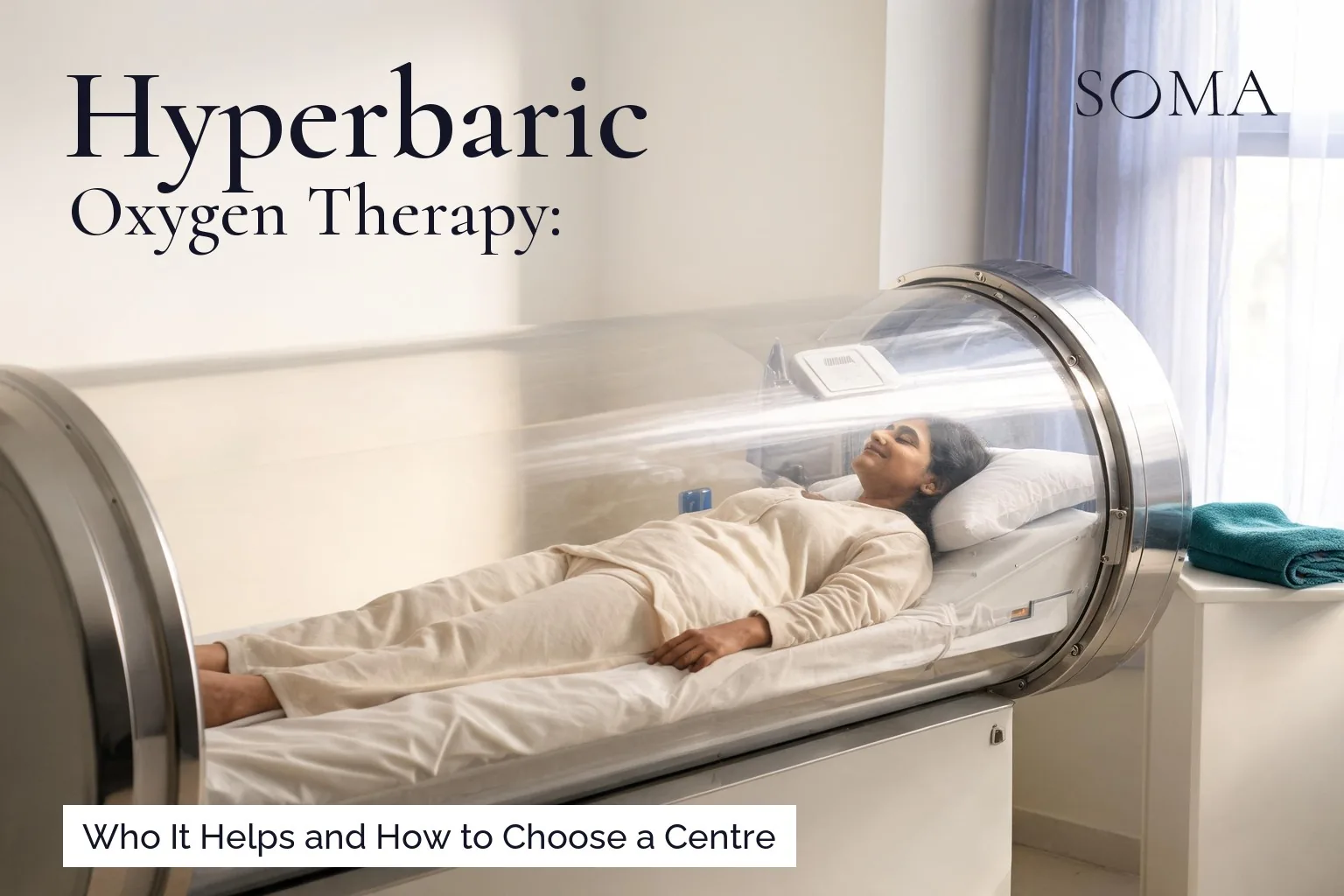
In short: Hyperbaric oxygen therapy (HBOT) means breathing pure oxygen inside a chamber pressurised to about two times normal air pressure. Under that pressure, your blood plasma carries many times more oxygen than usual. The extra oxygen reaches tissue with poor blood supply, supports repair, and switches on the body's own healing signals.
What is hyperbaric oxygen therapy?
You lie or sit in a sealed chamber. The air pressure is raised, usually to 2.0–2.4 atmospheres absolute (ATA, a measure of pressure where 1 is sea level). You breathe 100% oxygen through a hood or mask, or the whole chamber is filled with oxygen.
A session usually lasts 60–120 minutes. Most protocols are a course of sessions, often 20 to 60, five days a week. The number depends on the reason for treatment.
What does it do inside the body?
Oxygen dissolves into plasma. Normally almost all the oxygen in your blood rides on red blood cells. Under pressure, much more oxygen also dissolves directly into plasma, the liquid part of blood. That pushes oxygen further into tissues, including swollen or poorly supplied areas.
Repair signals switch on. Each session raises oxygen sharply, and it falls again afterwards. Researchers call this the hyperoxic-hypoxic paradox: the body reads the rise and fall as a signal to rebuild. Studies show this rhythm triggers the growth of new small blood vessels, releases stem cells from the bone marrow into the blood, and helps cells build new mitochondria (the parts of cells that make energy). Oxygen also fuels collagen, the protein that rebuilds damaged tissue.
Swelling settles. High oxygen narrows blood vessels slightly, which reduces swelling, while oxygen delivery still rises.
Infection defence improves. White blood cells need oxygen to kill bacteria. Some bacteria cannot survive in high oxygen.
Who is it used for?
In hospitals, HBOT is used, often alongside other treatment, for:
decompression sickness ("the bends") in divers, and air bubbles in the blood
carbon monoxide poisoning
crush injuries and severe soft-tissue infections
slow-healing wounds and skin grafts that are not taking
tissue damage that appears months or years after radiation treatment
stubborn bone infections and some serious burns
The Undersea and Hyperbaric Medical Society, a leading international society in this field, publishes the list of these uses.
In longevity and recovery medicine, doctors use HBOT for:
Recovery after COVID-19. In a 2022 trial in Scientific Reports, 73 adults with symptoms lasting months after COVID-19 had either 40 HBOT sessions at 2.0 ATA or a sham treatment. The HBOT group improved in overall thinking, attention, energy, sleep, mood, and pain interfering with daily life. Brain scans showed better blood flow.
Healthy ageing. In a 2020 study in the journal Aging, healthy adults aged 64 and over had 60 sessions; 30 completed the course. Telomeres (protective caps on chromosomes that shorten with age) in several immune cell types grew longer by over 20%. The share of senescent killer T cells (worn-out immune cells that build up with age) fell by about 11%.
Who should not have it?
HBOT is generally well tolerated in a properly run medical centre. A doctor must screen you first.
Not suitable: anyone with an untreated collapsed lung (pneumothorax).
Needs a doctor's assessment first: a past collapsed lung, lung disease such as COPD, a current cold or sinus infection, recent ear or chest surgery, uncontrolled fever, seizure disorders, severe claustrophobia, and pregnancy.
Common, mild effects: a feeling of fullness in the ears, like on a plane. Swallowing or yawning usually clears it. Ear pain should be reported straight away, as pressure can strain the eardrum. Some people notice temporary short-sightedness after many sessions; it usually returns to normal within weeks. Tiredness or a mild headache can follow a session.
Medical chamber or mild chamber: what is the difference?
This is the most important thing to check before you start.
Pressure: medical hbot, 2.0–2.4 ATA; "mild" or soft-shell chamber, about 1.3 ATA.
Oxygen breathed: medical hbot, 100%; "mild" or soft-shell chamber, often room air or a concentrator.
Where: medical hbot, hospitals and accredited hyperbaric units; "mild" or soft-shell chamber, wellness studios, homes.
The Australian and New Zealand Hyperbaric Medicine Group states that mild chambers do not usually give the body more oxygen than breathing oxygen through a mask at normal pressure. European hyperbaric societies (2022) call for proper safety standards, trained staff and an individual risk check for any chamber. The studies described above all used medical-grade chambers at 2.0 ATA or more.
How to choose a hyperbaric centre
Ask these questions before you book:
What pressure will I be treated at, and will I breathe 100% oxygen?
Is a doctor trained in hyperbaric medicine present during sessions?
Will I be screened (chest, ears, medicines) before the first session?
How many sessions does my protocol need, and how will progress be measured?
Is there emergency equipment and trained staff on site?
How a SOMA doctor decides if it is right for you
HBOT works best as one part of a plan, not on its own. At SOMA, your doctor first looks at the whole picture: your history, blood work, inflammation and oxygen-related markers, and what you want to change.
SOMA does not run a hyperbaric chamber. If HBOT fits, your SOMA doctor prescribes it: the pressure, the number of sessions, and what to measure before and after. You are guided to a suitable medical hyperbaric centre, and your doctor reviews your progress against the plan. Often HBOT is combined with nutrition, sleep and other therapies so the body can use the extra oxygen well.
SOMA centres in Mumbai and New Delhi
Doctors at either SOMA centre assess whether hyperbaric oxygen therapy suits you and may prescribe it. SOMA does not operate a hyperbaric chamber; sessions take place at an external medical hyperbaric unit.
Mumbai: A-507, Kohinoor Square, N.C. Kelkar Marg, Shivaji Park, Dadar West, Mumbai 400028. Phone +91 98671 94033.
New Delhi: E-354, Greater Kailash II, New Delhi 110048, serving Delhi NCR and Gurugram. Phone +91 87969 92001. More about the New Delhi centre.
The New Delhi centre is independently operated under licence from SOMA Longevity Sciences, and its own doctors lead care there. Both centres follow the same SOMA assessment and diagnostic standards. Online consultations are also available. Contact either centre.
Questions people ask
Is hyperbaric oxygen therapy safe?
In a medical centre, after screening, HBOT has a long safety record. The most common effect is ear fullness, which usually clears by swallowing. Rare complications include oxygen-related seizures and lung injury, and pure oxygen is a fire risk. That is why screening and trained staff matter.
How many sessions of HBOT are needed?
It depends on the reason. Carbon monoxide poisoning may need one to three sessions. Wound healing often needs 20 to 40. The ageing and post-COVID studies used 40 to 60 daily sessions. Your doctor sets the number and checks progress along the way.
Does a home hyperbaric chamber work?
Most home chambers are soft-shell units at about 1.3 ATA. The Australian and New Zealand Hyperbaric Medicine Group says they do not usually deliver more oxygen than a mask at normal pressure. The research results described above came from medical chambers at 2.0 ATA or more.
What does an HBOT session feel like?
As pressure rises, your ears feel full, as on a landing plane. Once at pressure, most people rest, sleep or watch something. You breathe normally through a hood or mask. Pressure is lowered slowly at the end. Most people return to their day straight after.
Can HBOT help with ageing?
In a 2020 study of healthy adults over 64, a course of 60 sessions lengthened telomeres in several immune cell types by over 20% and reduced the share of senescent killer T cells. A doctor can tell you whether it fits your longevity plan.
Where can I get hyperbaric oxygen therapy in Mumbai or Delhi?
Both cities have hospital-based medical hyperbaric units. Start with a doctor's assessment so the pressure, number of sessions and checks are set for you. Doctors at SOMA's centres in Dadar West, Mumbai and Greater Kailash II, New Delhi assess suitability and may prescribe HBOT; sessions take place at an external medical hyperbaric unit.
Sources
Undersea and Hyperbaric Medical Society. Hyperbaric Oxygen Therapy Indications, 15th edition.
Hadanny A, Efrati S. The hyperoxic-hypoxic paradox. Biomolecules 2020;10(6):958. https://pmc.ncbi.nlm.nih.gov/articles/PMC7355982/
Thom SR et al. Stem cell mobilization by hyperbaric oxygen. Am J Physiol Heart Circ Physiol 2006;290:H1378–H1386. https://pubmed.ncbi.nlm.nih.gov/16299259/
Zilberman-Itskovich S et al. Hyperbaric oxygen therapy improves neurocognitive functions and symptoms of post-COVID condition: randomized controlled trial. Scientific Reports 2022;12:11252. https://doi.org/10.1038/s41598-022-15565-0
Hachmo Y et al. Hyperbaric oxygen therapy increases telomere length and decreases immunosenescence in isolated blood cells: a prospective trial. Aging 2020;12(22):22445–22456. https://pubmed.ncbi.nlm.nih.gov/33206062/
Smart D, Bennett M. ANZHMG statement on mild hyperbaric therapy. Diving and Hyperbaric Medicine 2010;40(2):78–82. https://www.dhmjournal.com/images/IndividArticles/40June/Smart_dhm.40.2.78-82.pdf
ECHM–EUBS position statement on the use of "mild hyperbaric therapies" in humans, 2022.
StatPearls: Hyperbaric Oxygen Therapy Contraindications. https://pubmed.ncbi.nlm.nih.gov/32491593/ ; DermNet: Hyperbaric oxygen therapy. https://dermnetnz.org/topics/hyperbaric-oxygen-therapy
This article is for education and general information. It is not a substitute for a medical consultation, diagnosis or treatment. Results vary by individual biology.
Wondering what your own results would show? Start with a conversation.